
INCOTERMS
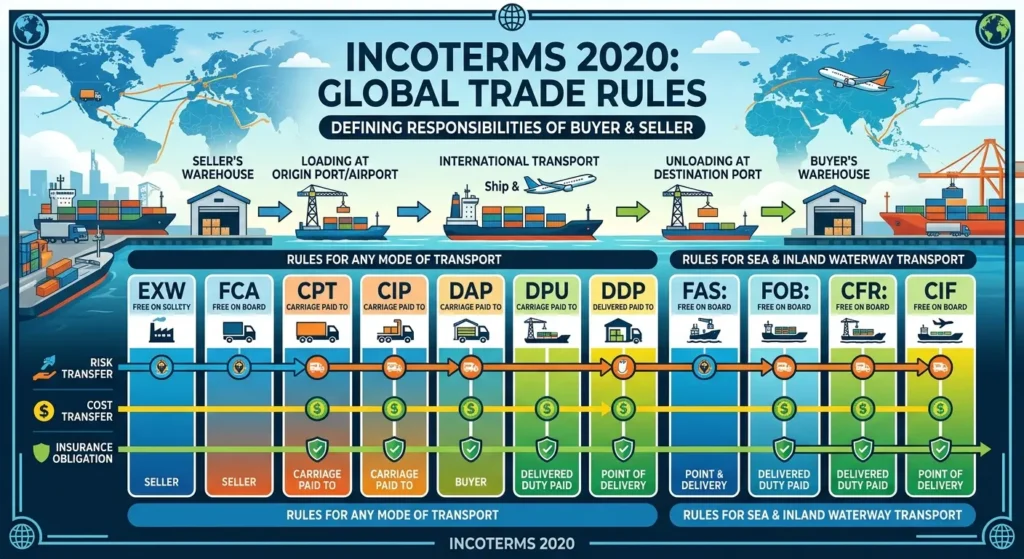
Incoterms and Delivery Terms
PETROBIZINT supplies petroleum products under five delivery methods: FOB, CIF, Tanker Take Over, Ship to Ship and Vessel to Vessel. Each one sets who arranges the vessel, who pays for freight and insurance, and where risk passes to the buyer.
How our delivery terms work
FOB and CIF are standard Incoterms published by the International Chamber of Commerce (Incoterms 2020). Tanker Take Over, Ship to Ship and Vessel to Vessel are transfer methods used in the petroleum trade. They are not ICC Incoterms, so their exact terms are written into each Sales & Purchase Agreement.
The five terms
FOB
Free On Board (Incoterms 2020)
- The seller delivers the product on board the vessel nominated by the buyer at the named loading port.
- Risk passes to the buyer once the product is on board.
- The buyer arranges and pays for the vessel, freight and cargo insurance.
- The seller clears the cargo for export and covers costs up to loading.
CIF
Cost, Insurance and Freight (Incoterms 2020)
- The seller arranges and pays for the vessel, freight and minimum cargo insurance to the named destination port.
- Risk still passes to the buyer once the product is on board at the loading port.
- The seller clears the cargo for export. The buyer clears it for import and pays discharge and later costs, unless the SPA says otherwise.
- Insurance covers the buyer's interest during the voyage.
TTO
Tanker Take Over
- The buyer's tanker takes over the product at the seller's storage terminal or tank farm.
- Quantity and quality are verified at transfer by independent inspection.
- Title and risk pass at the point set in the SPA, usually when the product leaves the storage tank outlet.
- The buyer arranges the tanker and its freight.
STS
Ship to Ship
- The product is transferred between two vessels at a designated anchorage or at sea.
- Operations follow industry STS transfer guidelines, with a qualified STS superintendent and mooring master.
- Quantity and quality are verified by independent inspection during the transfer.
- Title and risk pass at the point set in the SPA, normally when the transfer hose is disconnected.
VTV
Vessel to Vessel
- The product is transferred from the seller's vessel to the buyer's vessel, normally alongside at a port or terminal.
- Transfer is supervised by independent inspectors for quantity and quality.
- Port, berth and transfer window are agreed in advance by both parties.
- Title and risk pass at the point set in the SPA.
Comparison at a glance
| FOB | CIF | TTO | STS | VTV | |
|---|---|---|---|---|---|
| Vessel arranged by | Buyer | Seller | Buyer | Per SPA | Per SPA |
| Freight paid by | Buyer | Seller | Buyer | Per SPA | Per SPA |
| Insurance by | Buyer | Seller (minimum cover) | Buyer | Per SPA | Per SPA |
| Risk passes | On board at loading port | On board at loading port | At tank outlet, per SPA | At transfer, per SPA | At transfer, per SPA |
| Standard Incoterm | Yes | Yes | No | No | No |
Terms marked "per SPA" are fixed in the Sales & Purchase Agreement for each transaction.
From inquiry to delivery
- Buyer submits an ICPO stating product, quantity, delivery term and destination.
- PETROBIZINT issues the Soft Corporate Offer (SCO) with the agreed delivery term.
- Both parties sign the SPA, which fixes the term, port and risk transfer point.
- The payment instrument is issued and verified.
- Independent inspection, then loading or transfer under the chosen term.
- Delivery is completed with full documents, including Bill of Lading and inspection certificates.
Choose your delivery term
Tell us the product, quantity and preferred term. We will confirm availability, loading port and pricing.